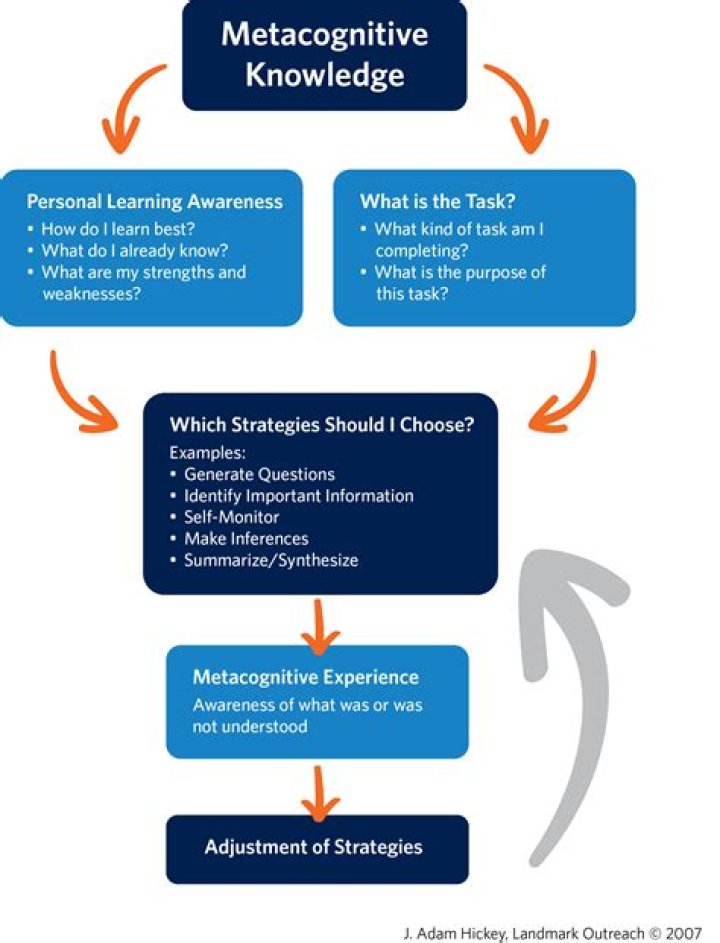
Individuals with well-developed metacognitive skills can think through a problem or approach a learning task, select appropriate strategies, and make decisions about a course of action to resolve the problem or successfully perform the task.
How do you identify metacognition?
Metacognition is, put simply, thinking about one's thinking. More precisely, it refers to the processes used to plan, monitor, and assess one's understanding and performance. Metacognition includes a critical awareness of a) one's thinking and learning and b) oneself as a thinker and learner.
What is an example of metacognition?
Metacognition also involves knowing yourself as a learner; that is, knowing your strengths and weaknesses as a learner. For example, if you can explain what your strengths are in academic writing, or exam taking, or other types of academic tasks, then you are metacognitively aware.
What are the characteristics of metacognition?
There are generally two components of metacognition: (1) knowledge about cognition and (2) regulation of cognition. Metamemory, defined as knowing about memory and mnemonic strategies, is an especially important form of metacognition.
How do you develop metacognition?
Metacognitive Skills
- Know What You Don't Know. ...
- Set yourself great goals. ...
- Ask Yourself Good Questions. ...
- Prepare Properly. ...
- Monitor your performance. ...
- Seek out feedback and then use it. ...
- Keep a diary.
What is poor metacognition?
Poor metacognition (Semerari et al., 2003), i.e., the capacity to understand mental states both of oneself and the others, and to regulate emotions and social behaviour on the basis of mentalistic knowledge has long identified in AvPD.
Is metacognition a skill?
Definition. Metacognitive skills are strategies applied consciously or automatically during learning, cognitive activity, and communication to manipulate cognitive processes before, during, or after a cognitive activity (Flavell, 1976, 1979).
Does everyone have metacognition?
While “inner language,” thought to be a prerequisite, begins in most children around age five, metacognition is a key attribute of formal thought flowering about age eleven. Interestingly, not all humans achieve the level of formal operations (Chiabetta, 1976).
What are the 3 metacognitive skills?
Here are a few examples of metacognitive skills:
- Task orientation. ...
- Goal setting. ...
- Planning and organization. ...
- Problem-solving. ...
- Self-evaluation. ...
- Self-correction. ...
- Reading comprehension. ...
- Concentration.
What are the five metacognitive skills?
Metacognitive Strategies
- identifying one's own learning style and needs.
- planning for a task.
- gathering and organizing materials.
- arranging a study space and schedule.
- monitoring mistakes.
- evaluating task success.
- evaluating the success of any learning strategy and adjusting.
What comes to your mind when you hear about metacognition?
Metacognition is also about being aware of your own actions and the effect of these on others and the environment. It is about being able to take conscious steps to reflect and evaluate and make mid-course corrections to improve outcomes.
What are metacognitive activities?
Activities for Metacognition
- Identify what they already know.
- Articulate what they learned.
- Communicate their knowledge, skills, and abilities to a specific audience, such as a hiring committee.
- Set goals and monitor their progress.
- Evaluate and revise their own work.
- Identify and implement effective learning strategies.
Is cognitive and metacognitive the same?
The meaning of the term cognitive is related to the process of acquiring knowledge (cognition) through the information received by the environment, learning. While metacognition refers to the ability of people to reflect on their thought processes and the way they learn.
Can metacognition be taught?
A metaphor that resonates with many students is that learning cognitive and metacognitive strategies offers them tools to "drive their brains." The good news for teachers and their students is that metacognition can be learned when it is explicitly taught and practiced across content and social contexts.
Does metacognitive therapy work?
Conclusions: Our findings indicate that MCT is an effective treatment for a range of psychological complaints. To date, strongest evidence exists for anxiety and depression. Current results suggest that MCT may be superior to other psychotherapies, including cognitive behavioral interventions.
What is metacognitive thinking?
Metacognition refers to the knowledge and regulation of one's own cognitive processes, which has been regarded as a critical component of creative thinking.
Is metacognition a disorder?
In clinical psychology, metacognitive strategies refer to the monitoring and control of thoughts related to a mental disorder. This includes both learned, unhealthy thought patterns that contribute to the problem, and learned behaviors used to break those patterns. Imagine a patient with generalized anxiety.
What is metacognitive training?
Metacognitive skills training (MST) is a cognitive rehabilitation approach which facilitates the development of self-awareness in patients with TBI [33–35]. The objective of MST is to teach individuals how to self-monitor their performance, identify and self-correct errors, and generate strategies for future use.
Which is the best example of a metacognitive skill?
Examples of metacognitive activities include planning how to approach a learning task, using appropriate skills and strategies to solve a problem, monitoring one's own comprehension of text, self-assessing and self-correcting in response to the self-assessment, evaluating progress toward the completion of a task, and ...
Who benefits more from having metacognitive skills?
Research shows that even children as young as 3 benefit from metacognitive activities, which help them reflect on their own learning and develop higher-order thinking.
Is Meta thinking good?
Metacognition has been linked to improved learning outcomes. It makes sense that individuals who are strategic in their learning are more successful than those who do not reflect on the learning process. For instance, metacognitive learners are more likely to notice when what they are studying does not make sense.
Is metacognition unique to humans?
It has long been assumed that metacognition—thinking about one's own thoughts—is a uniquely human ability. Yet a decade of research suggests that, like humans, other animals can differentiate between what they know and what they do not know.
How do I teach my child to metacognition?
7 Strategies That Improve Metacognition
- Teach students how their brains are wired for growth. ...
- Give students practice recognizing what they don't understand. ...
- Provide opportunities to reflect on coursework. ...
- Have students keep learning journals. ...
- Use a "wrapper" to increase students' monitoring skills. ...
- Consider essay vs.
What are the four types of metacognitive learners?
This is metacognition. Perkins (1992) defined four levels of metacognitive learners: tacit; aware; strategic; reflective. 'Tacit' learners are unaware of their metacognitive knowledge.
What does metacognition look like in the classroom?
For example, a student with metacognitive skills might: Recognise that they have trouble applying formulas in maths. Think about the maths problems they have solved before, and the strategies they used. Apply these strategies, assessing whether they are working or not.