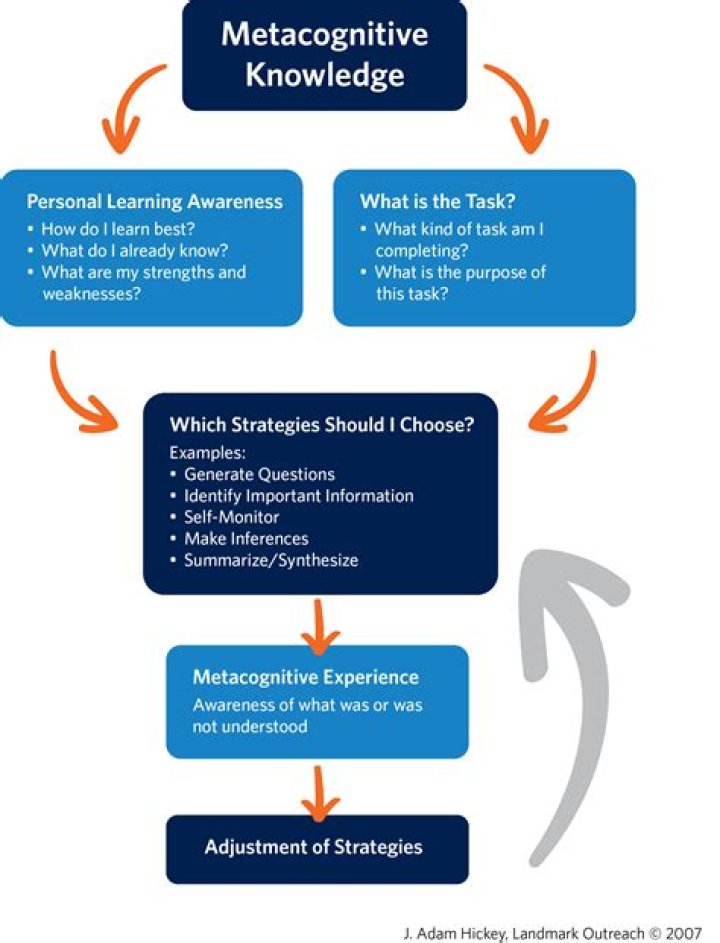
Below are three ideas for teaching metacognition to students struggling with reading:
- “Think aloud” while reading. Reading aloud is one of the first ways that educators introduce reading skills. ...
- Stop for reflection. ...
- Craft an inner monologue.
What are the three metacognitive reading strategies?
While reading. Metacognitive reading strategies are about taking charge of reading, monitoring comprehension while reading.
What are the 3 categories of metacognition?
Flavell further divides metacognitive knowledge into three categories: knowledge of person variables, task variables and strategy variables.
What are three 3 monitoring metacognitive strategies for improving reading comprehension?
There are several steps in metacognitive strategy which are used in teaching reading comprehension. According to Zhang and Sheepo (2013) metacognitive strategies are divided into three categories, they are: planning, monitoring, and evaluating.
What is the 3 metacognitive knowledge?
The metacognitive knowledge component of metacognition is divided into three different types of knowledge: Declarative knowledge. Procedural knowledge. Conditional knowledge.
34 related questions foundWhat are the 3 processes of metacognitive regulation and control?
Metacognitive regulation involves three processes: setting goals and planning, monitoring and controlling learning and evaluating own regulation.
What are the metacognitive strategies?
Strategies for using metacognition when you study
- Use your syllabus as a roadmap. Look at your syllabus. ...
- Summon your prior knowledge. ...
- Think aloud. ...
- Ask yourself questions. ...
- Use writing. ...
- Organize your thoughts. ...
- Take notes from memory. ...
- Review your exams.
What are the reading strategies?
General Strategies for Reading Comprehension
- Using Prior Knowledge/Previewing. ...
- Predicting. ...
- Identifying the Main Idea and Summarization. ...
- Questioning. ...
- Making Inferences. ...
- Visualizing. ...
- Story Maps. ...
- Retelling.
What are the three cognitive strategies?
Cognitive strategies are one type of learning strategy that learners use in order to learn more successfully. These include repetition, organising new language, summarising meaning, guessing meaning from context, using imagery for memorisation.
What are the 5 metacognitive strategies?
Metacognitive Strategies
- identifying one's own learning style and needs.
- planning for a task.
- gathering and organizing materials.
- arranging a study space and schedule.
- monitoring mistakes.
- evaluating task success.
- evaluating the success of any learning strategy and adjusting.
What are the three essential components of metacognition?
Metacognition is broken down into three components: metacognitive knowledge, metacognitive experience, and metacognitive strategies. Each of these is discussed in the following sections.
What are types of metacognition?
Metacognition is, put simply, thinking about one's thinking. More precisely, it refers to the processes used to plan, monitor, and assess one's understanding and performance. Metacognition includes a critical awareness of a) one's thinking and learning and b) oneself as a thinker and learner.
What are the teaching strategies that develop metacognition in students?
7 Strategies That Improve Metacognition
- Teach students how their brains are wired for growth. ...
- Give students practice recognizing what they don't understand. ...
- Provide opportunities to reflect on coursework. ...
- Have students keep learning journals. ...
- Use a "wrapper" to increase students' monitoring skills. ...
- Consider essay vs.
What are the 7 metacognitive strategies?
This is the seven-step model for explicitly teaching metacognitive strategies as recommended by the EEF report:
- Activating prior knowledge;
- Explicit strategy instruction;
- Modelling of learned strategy;
- Memorisation of strategy;
- Guided practice;
- Independent practice;
- Structured reflection.
What is metacognitive theory of reading?
Metacognitive control, in which the reader consciously directs the reasoning process, is a particularly important aspect of strategic reading. When readers are conscious of the reasoning involved in reading, they can access and apply that reasoning to similar reading in future situations.
What is metacognition and metacognitive strategies?
Metacognition is the ability to critically analyse how you think, or, in simple terms, having self-awareness and control of your thoughts. It is best described as developing appropriate and helpful thinking strategies at each stage of the task.
What is the difference between cognitive and metacognitive strategies?
The meaning of the term cognitive is related to the process of acquiring knowledge (cognition) through the information received by the environment, learning. While metacognition refers to the ability of people to reflect on their thought processes and the way they learn.
What are the types of cognitive strategies?
Selection, rehearsal, elaboration and organizational are the four types of cognitive strategies.
How are cognitive strategies different from metacognitive strategies?
Cognition vs Metacognition
Basically, cognition deals with mental processes such as memory, learning, problem-solving, attention and decision making. However, the metacognition deals with an individual's higher order cognitive processes , where a person has active control over his cognition.
What are the 3 models of reading?
According to Browne (1998), there are three major models of reading which are the bottom-up, top-down, and interactive models. effective because the emphasis here is on the letters, recognition of their shapes and reading individual words.
What are the 4 reading strategies?
These teaching strategies are intended to support and complement teaching and learning programming for reading in Stage 4.
- Analysing character.
- Audience and purpose.
- Author perspective and bias.
- Compare and contrast.
- Connecting ideas.
- Evaluating sources.
- Inference.
- Literal comprehension.
What are the 10 strategies in reading?
10 Fix-Up Reading Comprehension Strategies
- Re-read. This is one that most readers want to skip. ...
- Read out loud. Sometimes it just helps to hear yourself read out loud. ...
- Use context clues. ...
- Look up a word you don't know. ...
- Ask questions. ...
- Think about what you've already read. ...
- Make connections. ...
- Slow down.
What are the 6 metacognitive teaching strategies?
The six strategies are:
- Engage Students in Critical Thinking.
- Show Students How to Use Metacognitive Tools.
- Teach Goal-Setting.
- Instruct Students in How Their Brains Work.
- Explain the Importance of a Growth Mindset.
- Provide Opportunities for Existential Questioning.
What are metacognitive strategies PDF?
Metacognitive strategies are those strategies which require students to think about their own thinking as they engage in academic tasks.
What are the 7 metacognitive strategies for improving reading comprehension?
To improve students' reading comprehension, teachers should introduce the seven cognitive strategies of effective readers: activating, inferring, monitoring-clarifying, questioning, searching-selecting, summarizing, and visualizing-organizing.