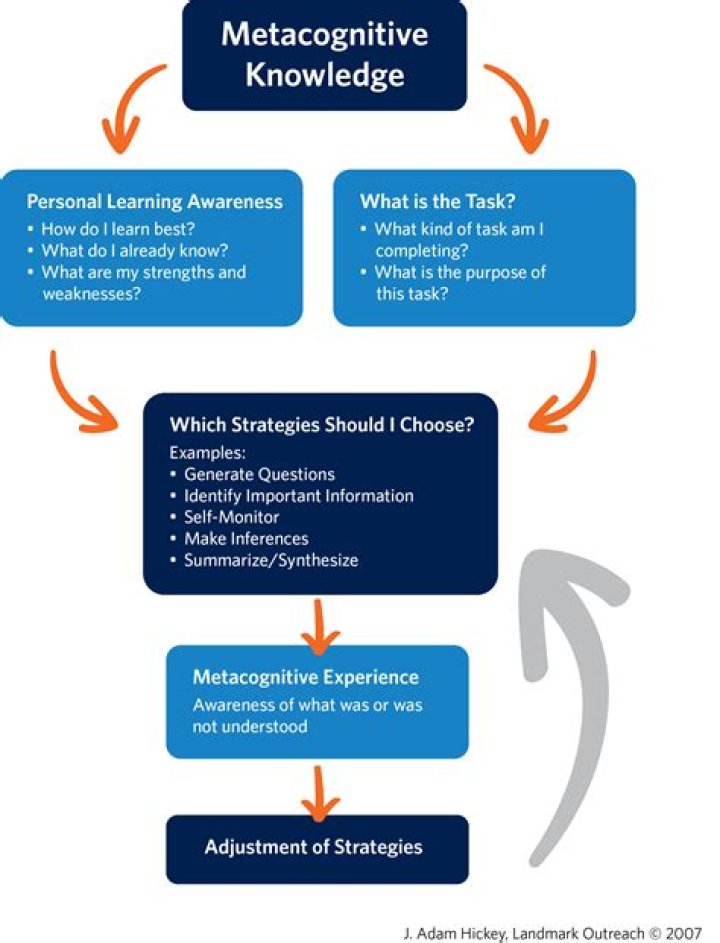
Metacognition is, put simply, thinking about one's thinking. More precisely, it refers to the processes used to plan, monitor, and assess one's understanding and performance. Metacognition includes a critical awareness of a) one's thinking and learning and b) oneself as a thinker and learner.
What is metacognitive learning examples?
Examples of metacognitive activities include planning how to approach a learning task, using appropriate skills and strategies to solve a problem, monitoring one's own comprehension of text, self-assessing and self-correcting in response to the self-assessment, evaluating progress toward the completion of a task, and ...
How is metacognition used in learning?
Strategies for using metacognition when you study
- Use your syllabus as a roadmap. Look at your syllabus. ...
- Summon your prior knowledge. ...
- Think aloud. ...
- Ask yourself questions. ...
- Use writing. ...
- Organize your thoughts. ...
- Take notes from memory. ...
- Review your exams.
What are the four types of metacognitive learners?
This is metacognition. Perkins (1992) defined four levels of metacognitive learners: tacit; aware; strategic; reflective. 'Tacit' learners are unaware of their metacognitive knowledge.
What are the 5 metacognitive strategies?
Metacognitive Strategies
- identifying one's own learning style and needs.
- planning for a task.
- gathering and organizing materials.
- arranging a study space and schedule.
- monitoring mistakes.
- evaluating task success.
- evaluating the success of any learning strategy and adjusting.
What are the 3 categories of metacognition?
Flavell further divides metacognitive knowledge into three categories: knowledge of person variables, task variables and strategy variables.
How does metacognition improve students learning?
Metacognition helps students recognize the gap between being familiar with a topic and understanding it deeply. But weaker students often don't have this metacognitive recognition—which leads to disappointment and can discourage them from trying harder the next time.
Why do we need to teach learn metacognition?
The use of metacognitive thinking and strategies enables students to become flexible, creative and self-directed learners. Metacognition particularly assists students with additional educational needs in understanding learning tasks, in self-organising and in regulating their own learning.
Why is metacognition important in learning?
Research shows metacognition (sometimes referred to as self-regulation) increases student motivation because students feel more in control of their own learning. Students who learn metacognitive strategies are more aware of their own thinking and more likely to be active learners who learn more deeply.
Is cognitive and metacognitive the same?
The meaning of the term cognitive is related to the process of acquiring knowledge (cognition) through the information received by the environment, learning. While metacognition refers to the ability of people to reflect on their thought processes and the way they learn.
What are the 7 metacognitive strategies?
This is the seven-step model for explicitly teaching metacognitive strategies as recommended by the EEF report:
- Activating prior knowledge;
- Explicit strategy instruction;
- Modelling of learned strategy;
- Memorisation of strategy;
- Guided practice;
- Independent practice;
- Structured reflection.
What are types of metacognition?
Metacognition is broken down into three components: metacognitive knowledge, metacognitive experience, and metacognitive strategies.
How do you explain metacognition to students?
For students, having metacognitive skills means that they are able to recognise their own cognitive abilities, direct their own learning, evaluate their performance, understand what caused their successes or failures, and learn new strategies. It can also help them learn how to revise.
What is the concept of metacognition?
Metacognition is, put simply, thinking about one's thinking. More precisely, it refers to the processes used to plan, monitor, and assess one's understanding and performance.
How is metacognition used in everyday life?
Metacognition refers to one's awareness of and ability to regulate one's own thinking. Some everyday examples of metacognition include: awareness that you have difficulty remembering people's names in social situations. reminding yourself that you should try to remember the name of a person you just met.
What is a metacognitive essay?
Metacognition Paper (metacognition means “thinking about thinking”). You will talk about previous years, as you've not had my class yet. This is one of the most important papers of the year. It does not require APA or research, but it does require thought.
Can metacognition be taught?
A metaphor that resonates with many students is that learning cognitive and metacognitive strategies offers them tools to "drive their brains." The good news for teachers and their students is that metacognition can be learned when it is explicitly taught and practiced across content and social contexts.
Why is metacognition so important for learning and memory?
Why is metacognition so important for learning and memory? People who have good metacognition are able to adjust their learning strategies when they are not effective.
Which is the best example of metacognition?
Here are some examples of metacognition:
- A student learns about what things help him or her to remember facts, names, and events.
- A student learns about his or her own style of learning.
- A student learns about which strategies are most effective for solving problems.
What is the difference between metacognition and metacognitive knowledge?
Metacognitive knowledge – this refers to a student's awareness of what they do or don't know about their cognitive processes. It includes knowing their strengths, weaknesses, and identifying gaps in their knowledge. This type of metacognition also refers to knowledge of skills that students may use to solve a problem.
How do I teach my child to metacognition?
7 Strategies That Improve Metacognition
- Teach students how their brains are wired for growth. ...
- Give students practice recognizing what they don't understand. ...
- Provide opportunities to reflect on coursework. ...
- Have students keep learning journals. ...
- Use a "wrapper" to increase students' monitoring skills. ...
- Consider essay vs.
What is metacognition Eyfs?
Metacognition is a word you may have heard being thrown around the educational arena more frequently in recent times. It sounds really tricky and scientific, and in a way it is, but when it comes down to it, metacognition merely means 'thinking about thinking'.
What are the 6 metacognitive teaching strategies?
The six strategies are:
- Engage Students in Critical Thinking.
- Show Students How to Use Metacognitive Tools.
- Teach Goal-Setting.
- Instruct Students in How Their Brains Work.
- Explain the Importance of a Growth Mindset.
- Provide Opportunities for Existential Questioning.
What is the strong distinction between cognitive and metacognitive learning strategies?
Basically, cognition deals with mental processes such as memory, learning, problem-solving, attention and decision making. However, the metacognition deals with an individual's higher order cognitive processes , where a person has active control over his cognition.
What are the three cognitive strategies?
Cognitive strategies are one type of learning strategy that learners use in order to learn more successfully. These include repetition, organising new language, summarising meaning, guessing meaning from context, using imagery for memorisation.