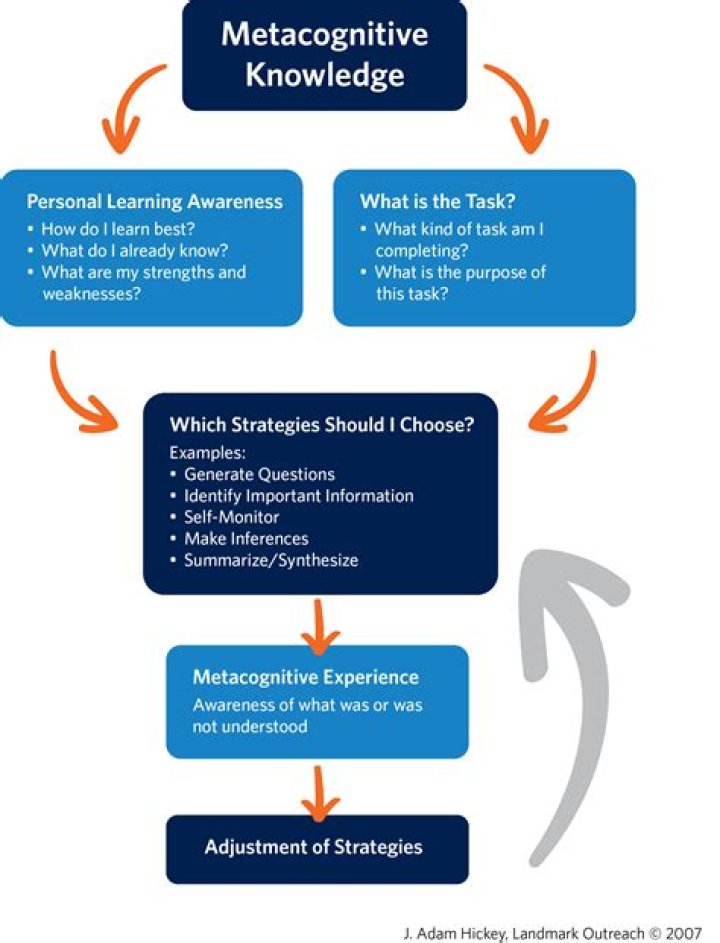
Metacognitive knowledge refers to what learners know about learning. This includes: - the learner's knowledge of their own cognitive abilities (e.g. 'I have trouble remembering dates in history') - the learner's knowledge of particular tasks (e.g. 'The ideas in this chapter that I'm going to read are complex')
What is the 3 metacognitive knowledge?
The metacognitive knowledge component of metacognition is divided into three different types of knowledge: Declarative knowledge. Procedural knowledge. Conditional knowledge.
What kind of knowledge is under metacognitive?
Metacognitive knowledge includes knowledge about the subject, knowledge of the task, and knowledge of the strategy. Metacognitive experience refers to the experience of their own cognitive process.
Why is metacognitive knowledge important?
It allows them to become aware of their own thinking and to become proficient in choosing appropriate thinking strategies for different learning tasks. Metacognitive knowledge also lays the foundation for the development of self-regulation, which is an essential pre-requisite for independent, self-directed learning.
What is metacognition example?
Metacognition also involves knowing yourself as a learner; that is, knowing your strengths and weaknesses as a learner. For example, if you can explain what your strengths are in academic writing, or exam taking, or other types of academic tasks, then you are metacognitively aware.
35 related questions foundWhat is knowledge cognition?
Knowledge of cognition includes knowledge used in approaching the questions 'what', 'how', 'when', and 'why' (Ma & Baranovich, 2015). Knowledge of cognition contains at least three aspects of cognitive awareness: declarative knowledge, procedural knowledge, and conditional knowledge (Schraw, 1998).
What are some metacognitive skills?
Here are a few examples of metacognitive skills:
- Task orientation. ...
- Goal setting. ...
- Planning and organization. ...
- Problem-solving. ...
- Self-evaluation. ...
- Self-correction. ...
- Reading comprehension. ...
- Concentration.
Why metacognitive knowledge is necessary for 21st century learners?
Perhaps the most important reason for developing metacognition is that it can improve the application of knowledge, skills, and character qualities in realms beyond the immediate context in which they were learned.
What is metacognitive knowledge for classroom teaching?
Metacognition refers to a student's knowledge of their own thought process. A metacognitive thinking process allows students to self-regulate and direct their thoughts, behaviors, and actions toward their goals.
What is metacognitive learning strategies?
Metacognitive strategies empower students to think about their own thinking. This awareness of the learning process enhances their control over their own learning. It also enhances personal capacity for self-regulation and managing one's own motivation for learning.
Is cognitive and metacognitive the same?
The meaning of the term cognitive is related to the process of acquiring knowledge (cognition) through the information received by the environment, learning. While metacognition refers to the ability of people to reflect on their thought processes and the way they learn.
What are the components of metacognitive knowledge?
Metacognitive knowledge is divided into three components, namely:
- knowledge statement ( declarative knowledge ) ...
- Procedural knowledge ( procedural knowledge ) ...
- knowledge-related ( Conditional knowledge )
What are the 4 types of metacognition?
Perkins (1992) defined four levels of metacognitive learners: tacit; aware; strategic; reflective.
What is the difference between metacognition and metacognitive knowledge?
Metacognitive knowledge – this refers to a student's awareness of what they do or don't know about their cognitive processes. It includes knowing their strengths, weaknesses, and identifying gaps in their knowledge. This type of metacognition also refers to knowledge of skills that students may use to solve a problem.
What is a metacognitive essay?
Metacognition Paper (metacognition means “thinking about thinking”). You will talk about previous years, as you've not had my class yet. This is one of the most important papers of the year. It does not require APA or research, but it does require thought.
What are examples of metacognitive strategies?
Examples of Metacognitive Strategies
- Self-Questioning. Self-questioning involves pausing throughout a task to consciously check your own actions. ...
- Meditation. ...
- Reflection. ...
- Awareness of Strengths and Weaknesses. ...
- Awareness of Learning Styles. ...
- Mnemonic aids. ...
- Writing Down your Working. ...
- Thinking Aloud.
How do students develop metacognitive skills?
Keep a diary
By keeping a diary of what you did, what you were thinking and how you felt, students will begin to build their self-awareness and develop their metacognitive skills. This may not come easy to some at first, but after a while, quickly becomes habit.
What is the importance of metacognition to teachers?
Teaching with metacognition enables teachers to gain awareness about and control over how they think and teach by planning, monitoring, evaluating, and adjusting their instructional goals and teaching strategies in accordance with their students' needs and the sociocultural context.
What is metacognitive knowledge Brainly?
Brainly User. Metacognitive knowledge refers to the information that individuals hold about their own cognition and about strategies which impact on it.
What is the role of metacognition in learning?
Metacognition is the ability to examine how you process thoughts and feelings. This ability encourages students to understand how they learn best. It also helps them to develop self-awareness skills that become important as they get older.
What is prior knowledge?
Prior knowledge is defined as all the knowledge one has before learning about a particular topic. As Dochy et al. (1999) point out, it facilitates learning new information. They estimate between 30 and 60% of the variance in learning outcomes is explained by prior knowledge.
What are the 8 cognitive skills?
The 8 Core Cognitive Capacities
- Sustained Attention.
- Response Inhibition.
- Speed of Information Processing.
- Cognitive Flexibility.
- Multiple Simultaneous Attention.
- Working Memory.
- Category Formation.
- Pattern Recognition.
What is a metacognitive process?
Metacognition is, put simply, thinking about one's thinking. More precisely, it refers to the processes used to plan, monitor, and assess one's understanding and performance. Metacognition includes a critical awareness of a) one's thinking and learning and b) oneself as a thinker and learner.
Is metacognition a learning theory?
The metacognitive theory is widely popular among educational and developmental psychologists. It can effectively explain how people regulate their own thinking to improve their efficiency in learning and work.
How does metacognitive knowledge metacognitive regulation and metacognitive instruction work together to help the learner have an effective learning?
Metacognitive practices help learners to monitor their own progress and take control of their learning as they read, write and solve problems in the classroom. Metacognition makes a unique contribution to learning over and above the influence of intellectual ability.